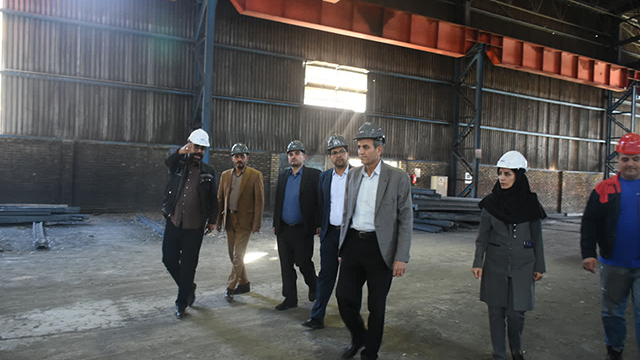
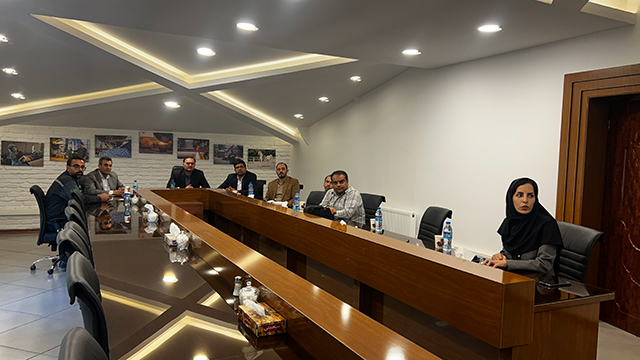

On Sunday, September 20, 2026, Dr. Hamed Bagheri-Farahani, Head of the Office of Scientific and International Cooperation at the University of Applied Science and Technology, accompanied by Dr. Shafiei, Head of the University of Applied Science and Technology in Kermanshah Province, and a group of experts from the Student Affairs Organization of the Ministry of Science, Research and Technology, visited Jahan Foulad Gharb University of Applied Science and Technology and the industrial facilities of Jahan Foulad Gharb Company.
The visit was attended by Mr. Mostafa Ahmadipour, CEO of Jahan Foulad Gharb Company, and Dr. Heydari, Acting Head of Jahan Foulad Gharb University of Applied Science and Technology. Discussions focused on the organization’s educational, skills-training, and industrial capacities, as well as potential areas for expanding scientific and international cooperation.
At the beginning of the meeting, Dr. Heydari presented an overview of the center’s activities, academic programs, and educational capacities. Emphasizing its skills-based approach, he described the center’s direct connection with the industrial environment as a key advantage in training a workforce aligned with labor market needs.
Jahan Foulad Gharb University of Applied Science and Technology offers specialized programs in areas including Metallurgy – Metal Smelting, Health, Safety and Environment (HSE), Steel Rolling, Occupational Safety and Technical Protection, Industrial Facilities, Machine Tools, and Cost Accounting, providing skills-based training for the workforce needs of various industrial sectors.
Mr. Mostafa Ahmadipour, CEO of Jahan Foulad Gharb Company, then highlighted the importance of skilled human resources in advancing industrial activities and emphasized the need to strengthen ties between industry and skills-training institutions.
He stated that industrial development is not possible without training specialized personnel equipped with the skills required by industry, adding that stronger links between universities of applied science and technology and industrial units can play an effective role in developing a workforce aligned with the industry’s actual needs.
Dr. Hamed Bagheri-Farahani, Head of the Office of Scientific and International Cooperation at the University of Applied Science and Technology, also highlighted the potential of universities of applied science and technology to expand skills-based education and emphasized the importance of leveraging institutions with direct industry links in developing international cooperation.
Referring to the potential of neighboring countries, particularly Iraq, he described the expansion of skills-based education for international students as an opportunity to broaden scientific and educational cooperation and familiarize foreign students with the industrial and economic capacities of the provinces.
Bagheri-Farahani also emphasized the need to prepare educational institutions to accommodate international students, develop educational and welfare infrastructure, introduce the institutions’ specialized capacities, and coordinate with the Student Affairs Organization.
Dr. Shafiei, Head of the University of Applied Science and Technology in Kermanshah Province, highlighted Kermanshah’s geographic location and shared border with Iraq, describing the province’s potential for expanding scientific, educational, and skills-based cooperation with countries in the region as significant.
He added that the presence of skills-based educational institutions alongside active industrial units creates valuable potential for training a workforce suited to the labor market needs of neighboring countries, and that Jahan Foulad Gharb University of Applied Science and Technology can play an effective role in this process.
He added that the presence of skills-based educational institutions alongside active industrial units creates valuable potential for training a workforce suited to the labor market needs of neighboring countries, and that Jahan Foulad Gharb University of Applied Science and Technology can play an effective role in this process.
At the conclusion of the visit, the participants discussed ways to expand skills-based education, strengthen university–industry ties, introduce the capacities of Jahan Foulad Gharb University of Applied Science and Technology, and establish the necessary foundations for expanding international educational activities, particularly for students from neighboring countries.