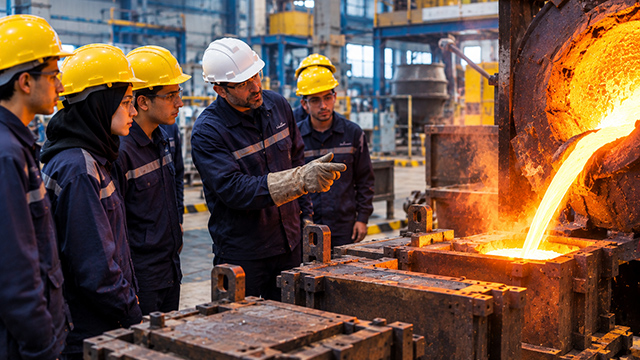
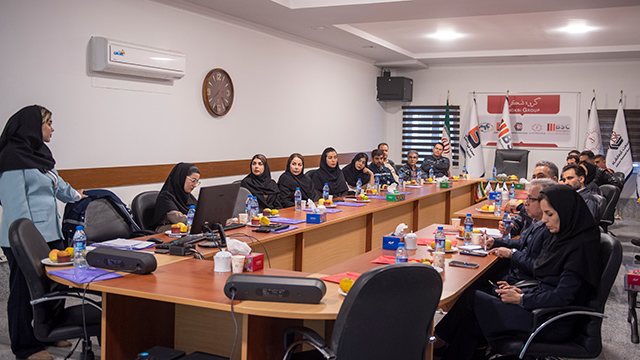

The specialized workshop, “The Carbon Era and New Requirements for Steel Trade with Europe,” focusing on the European Union’s Carbon Border Adjustment Mechanism (CBAM), was held on Sunday, November 1, 2026, organized by the Applied Science and Technology Education Center of Jahan Foulad Gharb Steel Complex.
The specialized workshop was conducted by Dr. Zahra Veisi, Head of Environmental Affairs at Bisotoun Steel Company, part of the Shokri Industrial Group, and an environmental specialist. It aimed to explain emerging carbon-related requirements and examine their impact on the production and trade of steel products.
The workshop was attended by a number of employees from the Shokri Industrial Group, while managers, experts, and specialists from the industrial and academic sectors participated online via the Skyroom platform.
Among the online participants were Dr. Amiri-Nejad, Director of Industry Relations at Razi University; Dr. Pahnaneh and Dr. Mojtahedi from Razi University; Dr. Abbasi from Babol University of Technology; and Engineer Moghadam, Secretary of the National Materials and Metallurgy Association.
The event was also livestreamed on the official Instagram page of Jahan Foulad Gharb, making it accessible to interested audiences.
Understanding the Scientific Fundamentals and International Standards of Carbon Emissions
The first part of the workshop covered the scientific fundamentals of climate change, types of greenhouse gases, emission sources, and Global Warming Potential (GWP). The concept of carbon footprint, the importance of measuring greenhouse gas emissions, and the methods used to calculate them were also examined.
The session further introduced international standards and frameworks for measuring, assessing, and reporting greenhouse gas emissions, including ISO 14064, ISO 14067, ISO 14040, and ISO 14044, as well as the Greenhouse Gas Protocol (GHG Protocol).
Another key training topic was the explanation of greenhouse gas emission scopes in organizations and industries. This section covered direct emissions (Scope 1), indirect emissions from purchased energy (Scope 2), and other indirect emissions throughout the value chain (Scope 3), along with the sources associated with each category.
CBAM: New Requirements for Steel Trade in the European Market
Another part of the workshop focused on the European Union’s Carbon Border Adjustment Mechanism (CBAM), its regulations and implementation requirements, as well as the latest developments in its regulatory framework.
This section explained the requirements of the definitive phase of CBAM implementation, the differences between calculating carbon emissions under this mechanism and calculating the carbon footprint of products, as well as the methods for determining carbon costs and the factors influencing the cost of CBAM certificates.
The impact of implementing these regulations on steel product exports, production costs, and industrial competitiveness was another topic of discussion. The institutional and administrative framework of the European Union for CBAM was also examined, including the responsibilities of relevant policymaking, implementing, supervisory, customs, and accreditation bodies.
Assessing the Carbon Footprint Across the Steel Production Chain
Given the importance of the steel industry in addressing new carbon regulations, a significant portion of the workshop focused on identifying direct and indirect greenhouse gas emission sources across steel production lines.
This section explained the process of assessing and calculating carbon emissions at various stages of the production chain, from raw material supply and direct reduction to steelmaking, casting, and rolling.
The relationship between CBAM requirements and the production and trade of steel products was also highlighted, along with the importance of accurately monitoring and recording greenhouse gas emissions.
Other topics included identifying the organizational departments involved in implementing carbon-related requirements and defining the responsibilities of environmental affairs, production, energy, laboratory, finance, commercial operations, and supply chain departments.
This highlighted the need for coordination among different industrial departments to obtain accurate and verifiable data.
Strategies for Reducing Carbon Emissions and Moving Toward Green Steel
The workshop continued with an examination of the future of the steel industry as it transitions toward a low-carbon economy, as well as developments in green steel production technologies.
Energy consumption optimization, heat recovery, the use of renewable energy, and the adoption of advanced low-carbon production technologies were among the strategies discussed for reducing greenhouse gas emissions in the steel industry and other industrial sectors.
he requirements for greenhouse gas emissions Monitoring, Reporting, and Verification (MRV) were also explained, along with the need to establish integrated mechanisms for recording, documenting, and assessing environmental data across industrial facilities.
One of the practical components of the course involved hands-on exercises in carbon footprint calculation. Participants were introduced to methods for assessing carbon emissions in industrial processes and across different stages of steel production.
Individual carbon footprints were also calculated based on four factors: transportation, food consumption, electricity consumption, and natural gas consumption. The exercise aimed to examine the contribution of each factor to greenhouse gas emissions and highlight the importance of modifying consumption patterns to reduce environmental impacts.
The organization of this specialized workshop was aimed at enhancing the technical and professional knowledge of the workforce, familiarizing participants with developments in international environmental and trade regulations, and increasing the readiness of industrial enterprises to address new carbon-related requirements.
In light of developments in global trade and the implementation of the European Union’s Carbon Border Adjustment Mechanism, these requirements are expected to play a significant role in shaping the future of steel exports, industrial competitiveness, and the sustainable development of the steel industry.