

Introduction to the Steel Beam Manufacturing Process
Steel beams are among the most important and widely used structural steel sections in the construction industry. They are manufactured in various types, each designed for specific applications. Due to their extensive use in building construction, the price of steel beams is considered one of the key factors influencing housing construction costs.
The earliest steel beams were designed with an I-shaped cross-section, commonly known as standard I-beams. However, with advancements in construction technology, materials engineering, and structural design, new beam profiles were developed to meet a wider range of structural requirements. One of the most widely used modern sections is the H-beam (Wide Flange Beam).
As is well known, the primary function of a steel beam is to support and transfer structural loads. Therefore, higher beam strength directly contributes to greater structural safety. Traditionally, increasing the strength of a beam meant increasing its thickness, which also resulted in a heavier structure.
In modern construction, excessive structural weight is considered undesirable. By optimizing the beam profile and cross-sectional design, engineers can achieve higher strength while minimizing the overall weight of the structure.
Steel Beam Manufacturing Standards
The standards governing steel sections vary according to regional regulations and intended applications. In Iran, several national standards are established for different types of steel beams, and manufacturers are required to comply with these specifications.
Steel beam standards are generally classified into four categories:
IPE
IPB
IPN
Cellular (Honeycomb) Beams
1. IPE Beams
Manufactured in accordance with Iranian National Standards:
- Hot-Rolled Parallel Flange I-Beams – Standard No. 1791
- Hot-Rolled Semi-Light Parallel Flange I-Beams – Standard No. 16348
2. IPN Beams
Hot-Rolled Tapered Flange Beams manufactured in accordance with Iranian National Standard No. 3277.
3. IPB (H-Beams)
Manufactured in accordance with Iranian National Standards:
- Light Section – Standard No. 13781
- Semi-Light Section – Standard No. 14484
- Heavy Section – Standard No 13779
Steel Beam Manufacturing Process
Like many other structural steel sections, steel beams are primarily manufactured using the hot rolling process. The production method has a significant impact on the quality of the finished product.
Hot rolling is the most important stage in beam production. Regardless of the beam size or standard, the overall manufacturing process remains largely the same for all beam types.
In the hot rolling process, steel blooms (billets) are used as the raw material. These blooms are heated and then formed into the desired cross-section through a series of rolling operations.
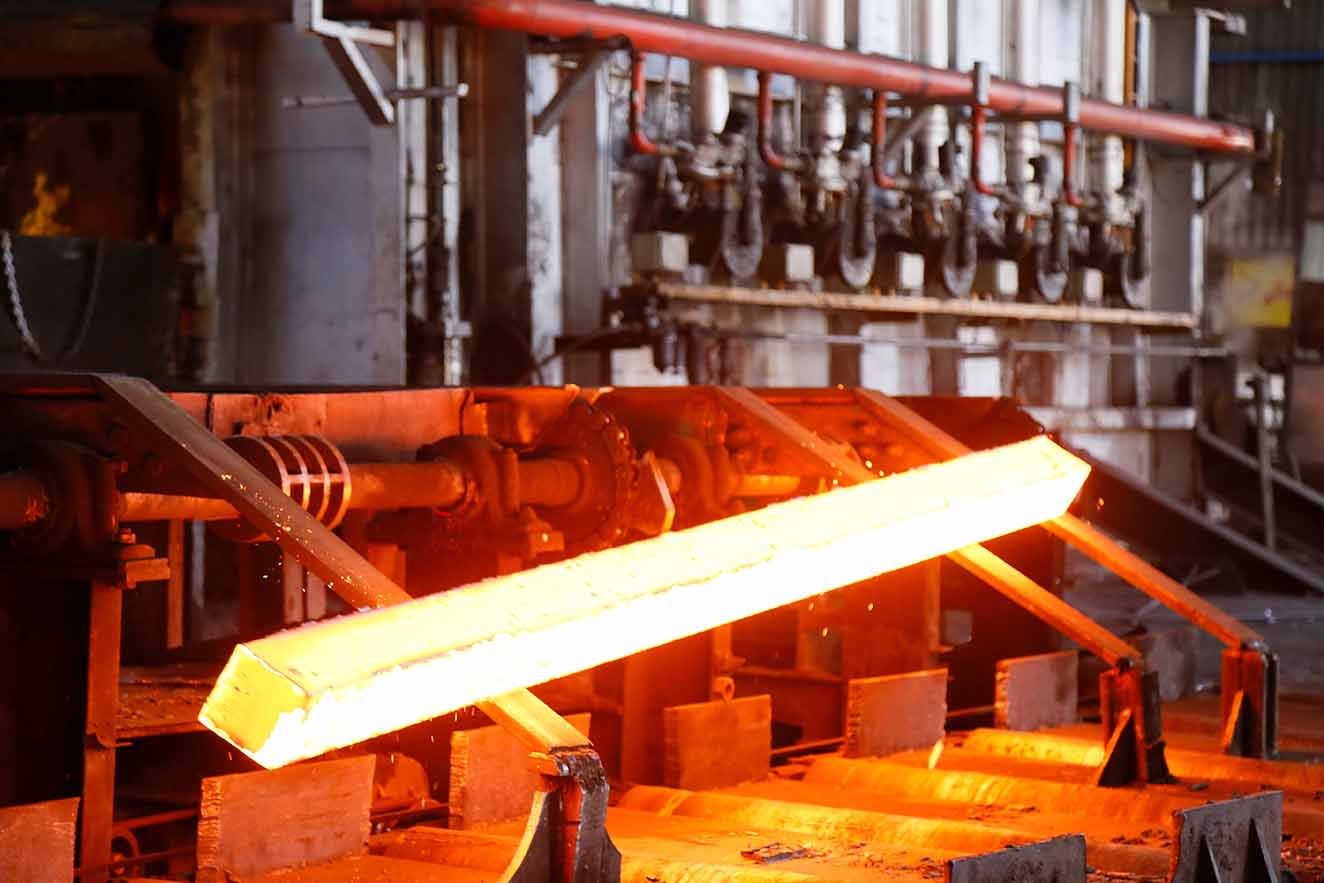
During production, the raw material is heated to approximately 1,100°C and fed through hydraulic equipment into large rolling mills, where it is progressively shaped into the required beam profile. This stage is known as the rolling process. After rolling, the beam surfaces are finished, straightened, and finally cut to standard lengths.
Steel beams can be classified into four categories based on their manufacturing method:
1. Rolled Beams
2. Extruded Beams
3. Welded Beams
4. Riveted Beams
Steel Beam Manufacturing Process at Jahan Foulad Gharb
Depending on the final product, raw steel blooms with lengths ranging from 4 to 6 meters and cross-sectional dimensions of 150 × 150 mm or 130 × 130 mm are charged into the reheating furnace.
From the time the blooms enter the furnace until they are discharged for production, approximately eight hours are required. During this period, the 200-ton reheating furnace gradually raises the temperature of the blooms to the required rolling temperature.
The reheating temperature depends on the bloom dimensions:
150 × 150 mm blooms: approximately 1,170°C
130 × 130 mm blooms: approximately 1,130–1,150°C
After leaving the furnace, the heated bloom enters the roughing mill, where it undergoes five primary rolling operations before being transferred to the finishing rolling stands.
The rolling stands are mechanically adjusted according to the required beam size and weight specified by the production order. Once the beam passes through the rolling line, it enters the cutting stage, where it is cut into the required lengths, such as 12 meters, 9 meters, or other customer-specified dimensions.
The freshly rolled beam, still at a high temperature, is then transferred to the cooling bed, where it cools to the proper temperature for straightening.
During the straightening process—commonly referred to as “beam leveling”—any bending or dimensional irregularities are removed. The finished beams are then bundled, packaged, and prepared for shipment and delivery to customers.